Case study · heat pump comparison
Most homes are best served by a monobloc heat pump. The refrigerant stays sealed inside the outdoor unit, installation is simpler, and models such as the Vaillant aroTHERM plus and Worcester Bosch Compress 5800i AW reach flow temperatures up to 75°C. A split system makes sense when the outdoor unit has to sit further from the house or you’d rather not run water pipes outside, but it needs an F-Gas qualified installer.
Monobloc and split heat pumps are both air-to-water systems. They take heat from the outside air and deliver it through your radiators or underfloor heating and into a hot water cylinder. The difference is where the refrigerant circuit sits and what runs between the outdoor unit and your home. Below we compare the two using real models from our Vaillant and Worcester Bosch pages. If you’re still weighing up the type of heat pump, read air source vs ground source heat pumps first, or head back to the heat pump hub.
What is a monobloc heat pump?
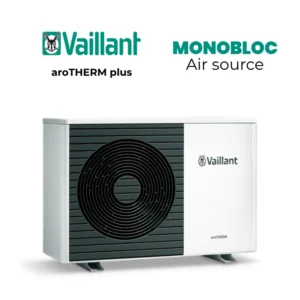
In a monobloc heat pump, the whole refrigerant circuit is built into the outdoor unit and sealed at the factory. Vaillant describes the aroTHERM plus as using monobloc technology with a hermetically sealed refrigerant circuit. Only heating water runs through the pipes between the outdoor unit and your home.
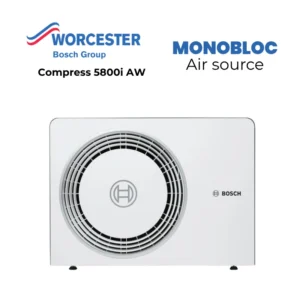
Because the installer never opens the refrigerant circuit, fitting is more straightforward. Worcester Bosch describes the Compress 5800i AW as F-Gas free fitting, with rear-facing connectors and a monobloc design for easier and quicker installation. The trade-off is that the water pipes running outside need good insulation and frost protection, and longer outdoor runs lose more heat, so the unit usually sits close to the house.
Both monobloc examples here use R290, a natural refrigerant also known as propane, with a very low global warming potential. Both are rated for flow temperatures up to 75°C, which gives more flexibility where some existing radiators stay in place.
What is a split heat pump?
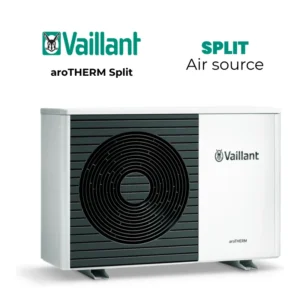
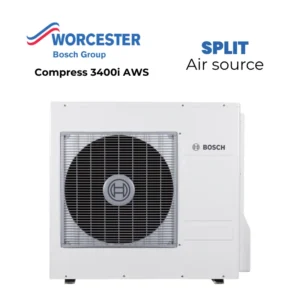
A split heat pump divides the system in two. The outdoor unit holds the fan and compressor, and an indoor unit passes the heat to your heating water. The two are linked by refrigerant pipes, so no heating water runs outside.
Vaillant says the aroTHERM Split outdoor unit can be installed up to 15m from the property, either wall-mounted or floor-standing. Worcester Bosch describes the Compress 3400i AWS as a compact split heat pump with space-saving outdoor units and a pre-configured indoor unit that includes a built-in electric booster for heating and hot water.
The catch is the refrigerant work. Connecting refrigerant pipes on site means the installer needs F-Gas qualifications, which GOV.UK requires for installing new heat pump systems that contain F gas. The split examples also differ on refrigerant and temperature. The aroTHERM Split uses R410A, which has a far higher global warming potential than R290, with heating flow up to 55°C. The Compress 3400i AWS uses R32, with flow up to 60°C.
Flow temperature and your radiators
Maximum flow temperature matters if you want to keep most of your existing radiators. A heat pump that can reach higher temperatures gives more headroom on the coldest days and for hot water. Even so, every heat pump runs most efficiently at the lowest flow temperature that keeps your home warm, so a room-by-room heat loss calculation should decide your radiator sizes, not the top figure on a datasheet. Our guide to heat pump retrofit vs full system upgrade explains how installers decide what can stay.
Installation, noise and servicing
With a monobloc, the installer connects water pipes, power and controls. With a split, they also run, test and commission the refrigerant lines, which adds a specialist step and narrows the choice of installer. Future servicing of the refrigerant side of a split system also needs an F-Gas qualified engineer.
On noise, both monobloc examples carry Quiet Mark certification. Worcester Bosch calls the Compress 5800i AW its quietest heat pump ever, and Vaillant’s Quiet Mark covers the 3.5, 5, 7 and 12kW aroTHERM plus models. Whichever design you choose, your installer should check the outdoor position for noise and planning before fitting.
Monobloc vs split at a glance
Which should you choose?
Choose monobloc if:
- You want the simplest installation and the widest choice of installers
- You prefer a natural R290 refrigerant
- You want higher flow temperatures to help keep more existing radiators
- The outdoor unit can sit close to the house
Choose split if:
- The outdoor unit has to sit well away from the house
- You’d rather not run heating water pipes outside
- Your installer holds F-Gas qualifications and recommends it for your site
Ready to compare monobloc models? See Vaillant aroTHERM plus vs Worcester Bosch Compress 5800i and Vaillant aroTHERM plus vs Viessmann Vitocal 250-A, or browse the Viessmann and Ideal ranges.
Frequently asked questions
Do monobloc heat pumps freeze in winter?
The refrigerant circuit is sealed inside the outdoor unit, but the water pipes running outside need protecting. Installers use insulation and frost protection designed for your system, so ask yours how they will protect the outdoor pipework.
Which is more efficient, monobloc or split?
Neither type is automatically more efficient. Efficiency depends on the specific model, the flow temperature your home needs and the quality of the design and installation. Compare like-for-like datasheet figures with your installer.
Does the grant cover both types?
The Boiler Upgrade Scheme gives £7,500 towards an air source heat pump in England and Wales, or £9,000 for off-gas-grid homes replacing oil or LPG until March 2027. Your installer confirms the system qualifies. In Scotland, Home Energy Scotland grants apply. See our grant guide.
Can any heating engineer install a split heat pump?
No. Fitting a split system means handling refrigerant, so the installer needs the right F-Gas qualifications. A monobloc installation doesn’t involve opening the refrigerant circuit, but you should still choose an installer trained in heat pump design.
Our recommended installer for your area will look at where the outdoor unit can go and recommend monobloc or split based on your property, not on what’s already in the van.
Find a recommended installerCompare heat pumps